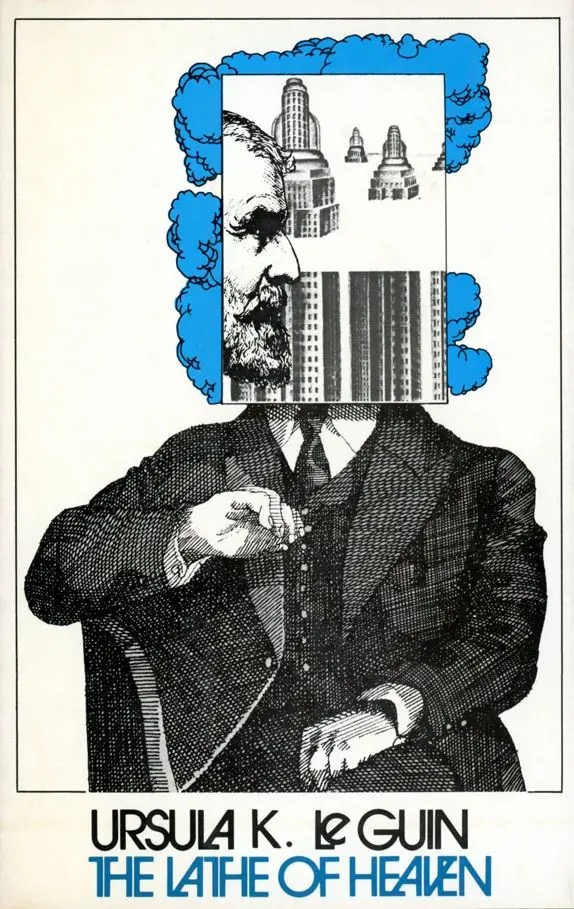
In Ursula K. Le Guin’s Lathe of Heaven, our protagonist George Orr is burdened with the ability to reshape the world through his dreams. When he is required to receive treatment by a dream psychologist, one Dr. Haber, Orr falls into blind loyalty and misplaced trust believing Haber has the best intentions, for him and the world at large.
George would rather be cured of his ability than use it to alter reality while Haber views Orr’s dreams as a means to an end. Through the doctor’s feigned superiority, Orr is forced to stay in treatment and participate in dream experiments. In these experiments, George is instructed to dream what Haber envisions as a better world. Over time, Haber sees the dreams as his own creation and frames his domination as benevolence.
George and his actions throughout the story represent ethical restraint and humility. He continually asks Haber to cure his ability and put an end to the experiments as he understands the consequences of intervention and the fragility of reality. Although Haber views his dreams as a “gift,” George feels as if he were cursed:
“He thought, I am living in a nightmare, from which from time to time I wake in sleep.”
In contrast, Haber represents control and benevolent authoritarianism. He aims to create a perfect world, one without war and conflict but one that is made through coercion. His performative humanitarianism mirrors modern elites who care more about outcomes than consent. Through continual gaslighting of his patient, he maintains his control and silences George’s valid concerns.
These two opposing forces embody the nature of humanity, and the story makes us question what role we would play if we had access to this kind of power. Would we intervene in current affairs like climate collapse and AI governance if we had the power to do so? Well, there are already major forces in power making these decisions for us. The more important questions are, who gets to decide how the world ought to be, and what exactly does this world look like?
Le Guin’s story addresses power, control, utopianism, free will, and institutional power. Well over fifty years later, the themes presented in her writing remain extremely relevant. We’re living through a time where the idea of “bettering the world” is often used as a moral shield for constraints and forced policy decisions.
I think this quote perfectly summarizes the theme of how reality is socially enforced by leaders with poor intentions:
“Of course, Haber thought, a man who saw a miracle would reject his eyes’ witness, if those with him saw nothing.”
The idea of an objective truth becomes a fallacy, the truth is instead what is collectively agreed upon. Is progress always moral and who is benefiting or being harmed from these “solutions.”
The Lathe of Heaven is a short read, one that will leave you thinking about its themes and questions well after reading. It is an amazing thought experiment that everyone will be able to relate to as the world around us is changing rapidly, quietly, and without our input. It’s up to us to remain skeptical and question those who are shaping that change.